
Customer Story
Drägerwerk AG & Co. KGaA
How an international leader in medical and safety technology gives its employees the best possible Microsoft 365 experience.
Drägerwerk AG & Co. KGaA
Medical & Safety Technology
Around 16,600
Global, 50+ countries
Digital Experience Monitoring for Microsoft 365
Challenges
Results
Dräger’s global IT team uses TrueDEM to see the Microsoft 365 experience from the endpoint all the way to the Microsoft cloud. The result: faster troubleshooting, fewer teams pulled into every ticket, and problems found before users report them — across all Microsoft 365 services for around 16,600 users in 50+ countries.
Running Microsoft 365 for 16,600 users worldwide
Dräger runs Microsoft 365 for its 16,600 users in more than 50 countries. From office staff and technical experts, to field service engineers working inside hospitals and other facilities.
Keeping the Microsoft 365 user experience smooth, at that scale and spread, is a serious undertaking. Especially considering that a large part of that workforce works remotely.
Before TrueDEM, monitoring and providing support was done mostly by using logs, Call analytics and CQD while also working closely with colleagues from his own and other teams responsible for the devices and networking.
The catch was reach. Some data needed to monitor and ensure user experience was there, but scattered across different logs, tools and teams while other data, like for instance home Wi-Fi and endpoint data was often completely missing or gone before anyone could use it. The fallback to resolve issues was slow and cumbersome: install Wireshark (a network analysis tool), ask the user to reproduce the problem, and hope the same error appeared again. It usually did not.
Dräger runs Microsoft 365 for its 16,600 users in more than 50 countries. From office staff and technical experts, to field service engineers working inside hospitals and other facilities.
Keeping the Microsoft 365 user experience smooth, at that scale and spread, is a serious undertaking. Especially considering that a large part of that workforce works remotely.
Before TrueDEM, monitoring and providing support was done mostly by using logs, Call analytics and CQD while also working closely with colleagues from his own and other teams responsible for the devices and networking.
The catch was reach. Some data needed to monitor and ensure user experience was there, but scattered across different logs, tools and teams while other data, like for instance home Wi-Fi and endpoint data was often completely missing or gone before anyone could use it. The fallback to resolve issues was slow and cumbersome: install Wireshark (a network analysis tool), ask the user to reproduce the problem, and hope the same error appeared again. It usually did not.
Heiko Dreibach has a broad background in networking, programming, and support processes and joined Dräger 15 years ago. After leading global service desk operations, he moved into Microsoft 365 administration and is now part of the team responsible for Dräger’s entire Microsoft 365 backend. Acting as a key connector between technologies, services, and stakeholders, he helps ensure the stability and continuity of the Microsoft 365 environment.

Closing the visibility gap
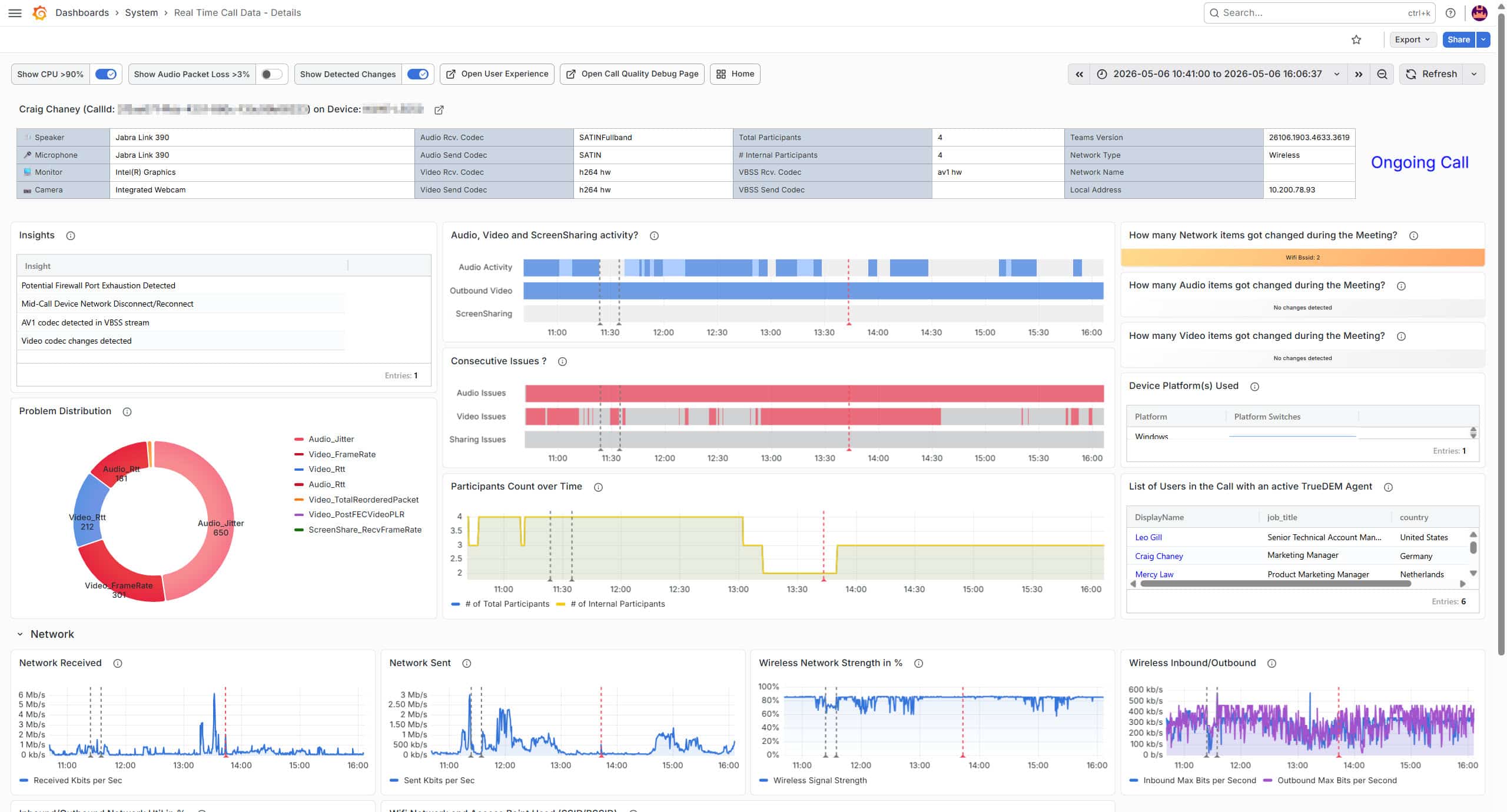
TrueDEM changed the starting point. Through it’s agent, TrueDEM collects experience data on the device itself, across the local, corporate and ISP network, and up to the Microsoft cloud. For the first time, the team could see the full path. Furthermore, the data is detailed instead of aggregated, so Heiko and his team can open a single call with ten people and see who is affecting whom, and what is really going on.
It also flipped the workflow around. Instead of being asked to produce data he did not have, Heiko now arrives with the evidence already in hand.
TrueDEM changed the starting point. Through it’s agent, TrueDEM collects experience data on the device itself, across the local, corporate and ISP network, and up to the Microsoft cloud. For the first time, the team could see the full path. Furthermore, the data is detailed instead of aggregated, so Heiko and his team can open a single call with ten people and see who is affecting whom, and what is really going on.
It also flipped the workflow around. Instead of being asked to produce data he did not have, Heiko now arrives with the evidence already in hand.
Getting ahead of the problem
Users often work around small disturbances rather than raise a ticket. They are busy, and that hiccup in the last Teams call, or mail that consistently seems a little delayed, is annoying, but not annoying enough to call a helpdesk and spend time getting it resolved.
But small issues can easily grow into bigger problems, so the real value for Heiko is catching those issues early and fixing them before they reach the level of causing serious issues. Insights from TrueDEM showed that up to 30% of issues detected are never formally reported.
A good example was a project to decommission a data center in Asia that left a reference to one of the old DNS servers in the configuration. Unable to find the decommissioned server, traffic from that region started falling back to DNS servers in Germany, which slowed everything down. With TrueDEM, the team was able to see the worsening trends and the inefficient routing. Giving them the ability to investigate and initiate remediation before users reported any problems.
The moment it proved its worth
The clearest example came from a meeting room used by Dräger’s senior management. One of the managers kept complaining that calls in that room were consistently bad. Through TrueDEM, Heiko was able to directly analyze the affected calls in TrueDEM and identify the cause: the room did not have sufficient Wi-Fi coverage, and the corner where the senior manager tended to sit was exactly where the signal was at its weakest.
An access point was added, and the complaints stopped. It is a small fix, but it is exactly the kind of physical, last-mile cause a cloud log would never reveal. It also shows the wider point: the experience of Microsoft 365 is shaped by everything along the path, not only by Microsoft.
Faster answers, with fewer people involved
Because the data is already there, the team spends less time gathering evidence and more time fixing the right thing.
It has also changed where the work happens. Dräger runs a deliberately skilled service desk, able to handle most first and second level incidents. The insights from TrueDEM continuously help build and improve the procedures and scripts the operators use to do their job. Preventing issues from having to be escalated up to the Microsoft 365 Operations team.
What comes next
If 2024 marks when Dräger started using it, Dräger has kept finding new ground to cover with TrueDEM. A new policy is being rolled out to open up additional endpoint information to TrueDEM, and more teams are being brought in to make use of the wealth of data it provides.
What comes next
If 2024 marks when Dräger started using it, Dräger has kept finding new ground to cover with TrueDEM. A new policy is being rolled out to open up additional endpoint information to TrueDEM, and more teams are being brought in to make use of the wealth of data it provides.
Dräger is an international leader in medical and safety technology, founded in 1889 and headquartered in Lübeck, Germany. The family-run company develops equipment and solutions that protect, support and save lives, with around 16,600 employees and sales and service operations in roughly 50 countries.
panagenda products in use:
Share this story